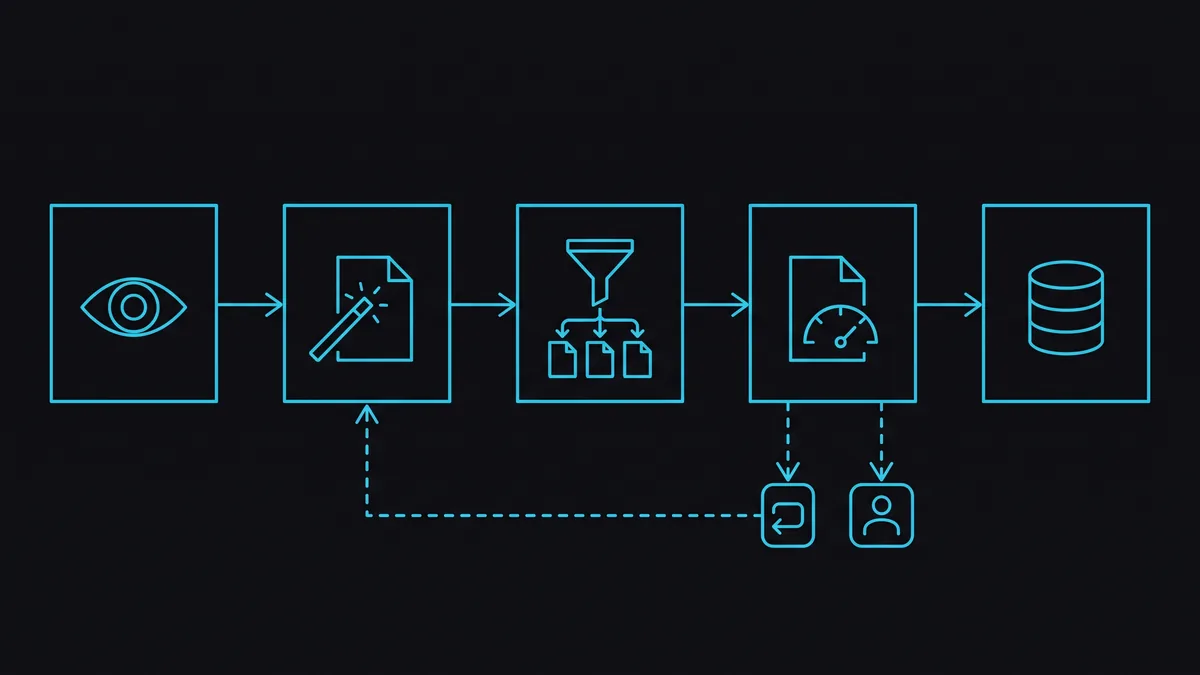
A medical document OCR pipeline is a staged system that moves clinical documents from capture to structured data: intake agents detect and collect documents, image enhancement repairs scans and faxes, classification decides what each document is, OCR extracts text with a confidence score, and routing sends structured extracts downstream. Recognition is one stage of five. Production failures cluster in the other four.
We have built each stage of this pipeline for clinical operators, and the pattern in the failures is consistent: nobody's OCR engine was the problem. Documents were lost before reaching it, arrived unreadable, were mislabeled, or passed through with wrong reads nobody scored. The pipeline framing exists because the engine-centric framing, "we need better OCR", spends money on the one stage that was already adequate.
The shape of the pipeline
Five stages, each with a specific failure it exists to prevent:
- Capture: documents reach the pipeline reliably, or nothing downstream matters. Failure prevented: lost and unprovenanced documents.
- Enhancement: scans and faxes are repaired before recognition. Failure prevented: unreadable inputs producing garbage reads.
- Classification: the pipeline decides what each document is before extracting from it. Failure prevented: right data extracted from the wrong document type.
- OCR with confidence: text extraction that reports how sure it is. Failure prevented: wrong reads entering the record unmarked.
- Routing: structured extracts delivered downstream, deduplicated, with fallbacks for low confidence. Failure prevented: duplicates, silent drops, and unbounded error propagation.
The order matters as much as the stages. Enhancement before classification, because a classifier scored on clean images misfires on raw faxes. Classification before OCR, because the document type decides what extraction even means, a lab result, a signed consent, and a claim form have different fields worth reading.
Capture: watchers, not uploads
Manual upload is where clinical documents go to disappear. The reliable pattern is unattended capture: file-system watcher agents at every endpoint that detect new documents, hash them for chain of custody, and push them to a central store, no staff action involved. That is the architecture of our clinical document watcher, a fleet of agents that replaced scheduled FTP polls and manual uploads that had been losing and duplicating documents for years.
Two properties make capture production-grade. Offline resilience: when the network or the central store is down, agents buffer locally with checkpoint markers and resume without duplicates when connectivity returns. An endpoint outage stops being a data-loss event. Provenance from the first touch: cryptographic hashing at capture means every document's chain of custody starts at the source, which is what turns a compliance question into an audit-log query instead of a forensic project.
Enhancement before recognition
Medical documents arrive in the worst states paper can produce: skewed scans, noisy faxes, low-contrast photocopies of photocopies. A human reads them; a model does not. Feeding them to OCR directly yields confident-looking garbage, and garbage that enters a clinical record costs far more to remove than to prevent.
The enhancement stage we built for this, described in the scan and fax enhancement case, runs deskew, denoise, and contrast normalization, with a small classifier picking the right enhancement profile per input type: scan, fax, or photo of paper. The critical addition is OCR-readability scoring before recognition: inputs that remain unreadable after enhancement are re-processed with stronger filters, and persistent failures escalate to human review instead of proceeding. Every transformation writes an audit record, so the record can always show what was done to an image before anything read it.
Classification and extraction
Classification assigns each document a type, and the type drives everything after: which fields to extract, which validations apply, where results route. Getting this wrong is worse than failing, a lab value extracted from the wrong form is a plausible-looking error, so classification confidence deserves the same routing discipline as OCR confidence: high-confidence classifications proceed, low-confidence ones fall back or escalate.
Extraction then runs with a confidence contract: every read carries a score, and the score decides the route. High-confidence reads flow to the clinical data sink; low-confidence reads take a fallback path, stronger preprocessing, a second engine, or barcode decode where documents carry one; persistent failures land in an escalation queue with their processing history attached. The invariant worth defending: no read enters the record without a confidence decision attached. Silent acceptance is how OCR errors become clinical data.
Throughput under bursty load
Clinical document flow is bursty: batch drops, morning fax floods, end-of-quarter surges. Average-load sizing guarantees backlog at exactly the busy moments. The pipeline we describe in the image classification and OCR case replaced synchronous workers that fell behind under burst and lost frames during GPU saturation, the two standard throughput failures.
What replaced them: a worker pool with self-tuning batch sizes, sized against GPU memory where models are involved; content-hash deduplication so replayed and re-sent documents cost nothing downstream; and queue depth plus per-stage latency as first-class metrics, because a backlog you can see forming is an operations event, and a backlog you discover from a downstream alarm is an incident. Bounded per-image cost through tunable batching means load spikes degrade latency gracefully instead of dropping frames.
Assembled, the five stages form a system where the interesting property is not accuracy on clean pages, every engine has that, but behavior on the worst page of the worst fax on the busiest day. That is the standard clinical operators actually need, and building to it, capture through routing, under audit, is part of our healthcare integration practice.
Common questions
What is an OCR pipeline?
A system that moves documents from capture to structured data through staged processing: intake, image enhancement, classification, optical character recognition, confidence scoring, and routing. The pipeline framing matters because recognition itself is one stage of six, and production failures cluster in the other five.
Why do medical documents need image enhancement before OCR?
Because scans and faxes arrive skewed, noisy, and low-contrast, readable to a human but not to a model. Deskew, denoise, and contrast normalization before recognition raise input quality to a level the OCR engine can rely on, and readability scoring catches the inputs that still cannot be trusted.
How do you catch OCR errors before they reach the clinical record?
Confidence scoring plus routing. High-confidence reads flow through; low-confidence reads take a fallback path with a second engine or stronger preprocessing; persistent failures escalate to human review. The principle is that no read enters the record without a confidence decision attached.
What volumes can a pipeline like this sustain?
Bursty load is the real test, not average load. Worker pools with self-tuning batch sizes, GPU-aware scheduling where models are involved, and content-hash deduplication let a pipeline absorb spikes without losing frames, while queue depth and per-stage latency metrics make backlogs visible before downstream consumers notice.
We built this in production
Image classify and OCR pipeline
High-volume image classification and OCR pipeline with GPU-aware batch scheduling and a variable worker pool. Structured clinical data extracts route downstream with content-hash deduplication. Survives bursty load witho...
Clinical document watcher
Fleet of .NET clinical document watcher agents running unattended at provider endpoints. Each agent detects signed documents, OCRs where needed, and pushes to a central store with chain-of-custody hashing. Buffers locall...
Document reformat at scale
Memory-bounded streaming pipeline that converts clinical document corpora across PDF, TIFF, DOCX, structured XML, and clinical CDA. Structure survives format hops. Every transformation step writes an audit record with in...
Keep reading
OCR fallback and barcodes in document pipelines
What an OCR fallback path is, when barcodes beat text recognition entirely, and how confidence scoring decides which route a document takes through a pipeline.
HEDIS automation: a pipeline auditors can reproduce
How a HEDIS measurement pipeline automates intake, classification, and measure calculation so numerators and denominators reproduce on demand for NCQA audit.
This is the standards side of what we do. The engineering practice behind it, HEDIS pipelines, FHIR platforms, and clinical document systems built under BAA, lives on the healthcare integration page.
Working on something in this space?
Describe the system and the standard you are up against. The engineer who answers is the engineer who ships it.