An OCR fallback is a second processing route for documents the primary recognition pass cannot read reliably: stronger image filters, a different engine, a different extraction strategy, or a barcode decode where the document carries one. The trigger is a confidence score below threshold. The alternative to having a fallback is not higher accuracy, it is silent corruption of whatever consumes the output.
Every OCR engine fails on some real-world input; that is not a vendor problem, it is the nature of paper that has been faxed, rescanned, and photocopied on its way to you. The engineering question is what happens next. In the pipelines we run for clinical operators, the difference between a system people trust and one they quietly work around has never been the engine. It has been whether failure is routed or ignored.
Why a fallback path exists
Consider the failure without one. A degraded fax enters the pipeline, the engine produces a low-quality read, and the read proceeds because nothing stops it. The error surfaces weeks later inside downstream data, where finding its origin costs a hundred times what catching it at extraction would have. In clinical settings this is how OCR noise becomes part of the record, and it is why one of our enhancement builds began with exactly that history: bad inputs leaking into the clinical record before anyone realized, and clinicians losing trust in the whole pipeline, the situation described in our scan and fax enhancement case.
A fallback path converts that silent failure into a routed one. The document gets a second chance at being read correctly, and if every chance fails, it gets a human. Nothing proceeds unmarked. The cost is a queue and some routing logic; the benefit is that the pipeline's error rate becomes a managed number instead of an unknown one.
Confidence scoring and routing
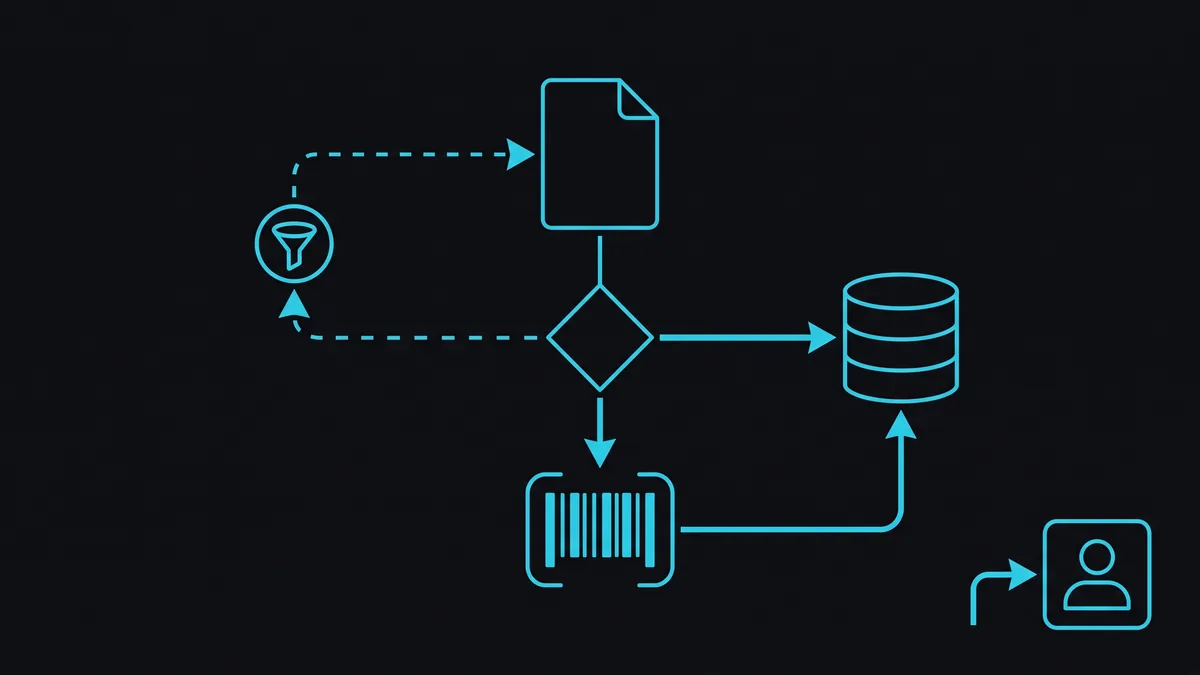
The mechanism is a confidence contract: every read carries a score, and the score decides the route. High-confidence reads proceed downstream. Low-confidence reads trigger the fallback: re-enhancement with stronger filters, a second recognition pass, or an alternate extraction strategy. Documents that fail repeatedly escalate to human review. In the classification and OCR pipeline we built, the fallback OCR path activates automatically when the primary classifier returns low-confidence results, no operator in the loop for the routine case.
Where should the threshold sit? Where your downstream error tolerance says, and that is a measurement, not a guess. Build a labeled sample from your real document mix, worst inputs included, sweep the threshold, and watch two numbers: the false-accept rate (bad reads that proceed) and the fallback rate (volume taking the slow path). A threshold tuned on clean test scans will happily pass documents in production that a clinical reviewer would reject; only the real mix tells the truth.
Two disciplines keep the contract honest over time. Re-measure when anything upstream changes, a new scanner fleet, a new fax provider, a new document source, because the input distribution is the threshold's foundation. And log the score with every read, accepted ones included: the drift of accepted-read confidence is your earliest warning that input quality is degrading.
Where barcodes beat OCR
The strongest fallback is not reading text at all. Wherever you control document generation, cover sheets, requisitions, labels, routing slips, a barcode carries identity and routing data with near-perfect read rates on inputs that defeat text recognition entirely. A fax that turns typed digits into smudge still yields a clean barcode decode, because barcodes were engineered for exactly that abuse and human handwriting was not.
The division of labor that follows: encode what you control, recognize what you cannot. Document identity, patient linkage, and routing live in the barcode; OCR handles only the content that could not be encoded, the clinical substance of the page. This shrinks the failure surface dramatically, because the highest-stakes fields, which record does this page belong to, stop depending on recognition at all. Barcode processing in document pipelines is unglamorous, which is roughly why it is underused: it solves the problem before the interesting technology gets a chance to fail at it.
Barcodes also compose with capture. An agent that detects a document at the source, like our clinical document watcher fleet, can decode the barcode immediately and attach identity to the file from its first moment in the system, so even a document that later defeats every OCR pass is never an orphan.
The escalation queue
Documents that fail enhancement, fail primary OCR, fail the fallback, and carry no barcode land in the escalation queue for human review, with their full processing history attached: what was tried, what scores resulted, what the image looked like at each stage. The history matters; a reviewer who can see that three passes produced three different low-confidence reads works differently than one handed a bare image.
Treat the queue as a feature, not an embarrassment. It is the mechanism that bounds automation risk: the pipeline never has to choose between guessing and stalling, because there is always a third route. And its volume is the honest health metric of everything upstream, when enhancement improves, the queue shrinks; when a new document source arrives degraded, the queue says so within a day. A pipeline whose escalation queue is empty is not perfect; it is almost certainly accepting reads it should not.
Fallback, barcodes, escalation: none of it is novel, all of it is routing discipline applied to recognition. The engines will keep improving and the discipline will keep being the differentiator, because the worst fax of the day does not care which model year your OCR is. The full pipeline this sits inside, capture to clinical record, is laid out in our medical document OCR pipeline breakdown, and the practice that builds them lives on the healthcare integration page.
Common questions
What is an OCR fallback?
A second processing route for documents the primary recognition pass cannot read reliably: stronger image filters, a different engine, or a different extraction strategy entirely. The trigger is a confidence score below threshold, and the alternative to having one is silent corruption of downstream data.
When are barcodes better than OCR?
Whenever you control document generation. A barcode carries identity and routing data with near-perfect read rates on inputs that defeat text recognition: faxed cover sheets, rescanned copies, degraded prints. OCR then only has to handle the content you could not encode, which shrinks the failure surface dramatically.
What confidence threshold should trigger a fallback?
The one your downstream error tolerance implies, measured, not guessed. Set it from a labeled sample of your real document mix, then watch the false-accept rate. A threshold tuned on clean test scans will pass documents in production that a clinical reviewer would reject.
What happens to documents that fail every pass?
They go to an escalation queue for human review, with the processing history attached. The queue is a feature, not an admission of defeat: it bounds the automation risk, and its volume is the honest metric of how well the rest of the pipeline works.
We built this in production
Scan and fax image enhancement
Server-side enhancement pipeline for medical document imaging. Deskews, denoises, and normalizes contrast on scans and inbound faxes, then scores OCR readability before any document reaches the clinical record. Persisten...
Image classify and OCR pipeline
High-volume image classification and OCR pipeline with GPU-aware batch scheduling and a variable worker pool. Structured clinical data extracts route downstream with content-hash deduplication. Survives bursty load witho...
Clinical document watcher
Fleet of .NET clinical document watcher agents running unattended at provider endpoints. Each agent detects signed documents, OCRs where needed, and pushes to a central store with chain-of-custody hashing. Buffers locall...
Keep reading
Medical document OCR: an intake-to-record pipeline
The stages of a medical document OCR pipeline: capture, enhancement, classification, extraction, and routing, with the failure modes each stage exists to stop.
Clinical data aggregation: architecture that scales
What a clinical data aggregation platform does, the hub pattern that stops every consumer re-integrating every source, and the failure modes to design against.
This is the standards side of what we do. The engineering practice behind it, HEDIS pipelines, FHIR platforms, and clinical document systems built under BAA, lives on the healthcare integration page.
Working on something in this space?
Describe the system and the standard you are up against. The engineer who answers is the engineer who ships it.