HEDIS automation is the replacement of manual quality-measure production with a pipeline that ingests clinical documents and claims, classifies and normalizes them against the current measure year, and emits numerators, denominators, and exclusions that reproduce on demand. HEDIS is the NCQA standard payers use to score care quality, and the property auditors actually test is not the calculation, it is the reproducibility.
The manual version of this work is easy to picture because most organizations start there: documents and claims pulled from many sources, triaged in spreadsheets, values folded into measures by hand, and a quarterly scramble to reconstruct how any number was produced. It fails in a specific order, and knowing the order is useful because it predicts what automation must fix first.
What HEDIS actually demands
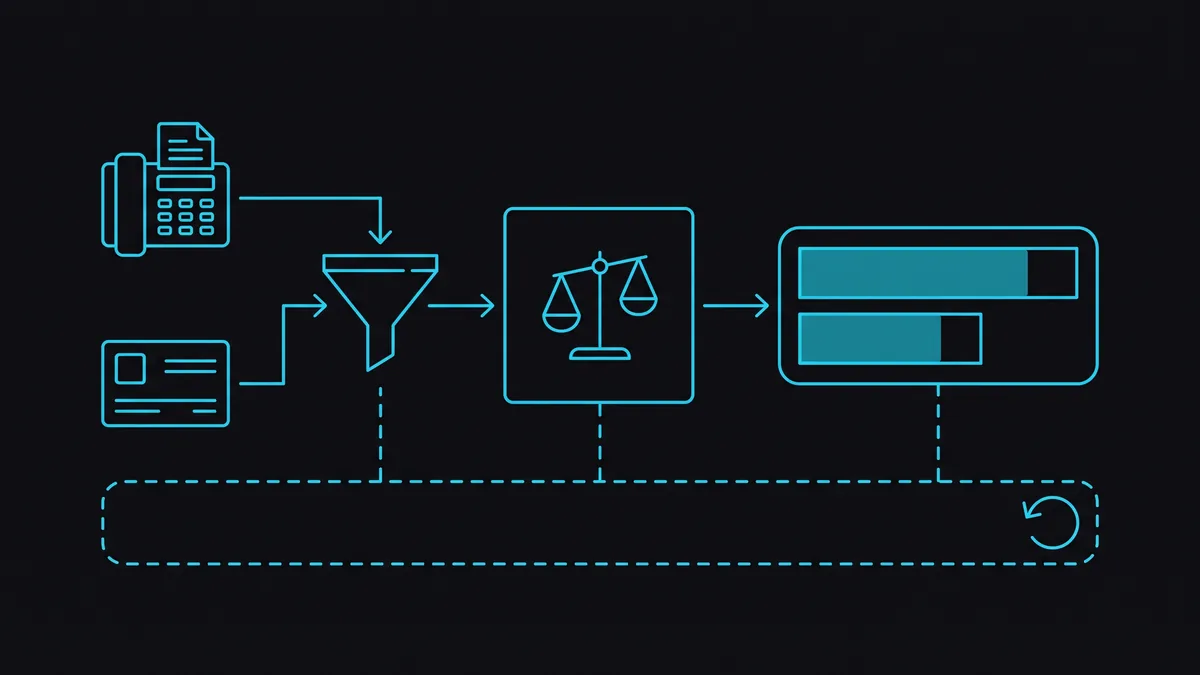
Producing a HEDIS measure means pulling clinical documents and claims from many sources, classifying them, normalizing fields, and computing measure logic against the current measure year. Each step is tractable. What makes the whole demanding is the audit posture: an auditor must be able to reproduce your numerators and denominators, which means every value in a submission needs a traceable path back to raw inputs.
Manual processes break on exactly that. Spreadsheet triage produces measures nobody can regenerate two months later, because the process lived in a person's working memory and a folder of intermediate files. Reproducibility breaks first; volume breaks second, when the document and claim flow a payer contract implies outgrows what any team can classify by hand. The automation case is usually argued on volume, but the audit argument is stronger: a pipeline is the only way reproducibility becomes a property of the system rather than a heroic quarterly effort. This is the ground our HEDIS measurement pipeline was built on, replacing spreadsheet triage that had failed at scale and an earlier automation attempt that lost orders to race conditions.
Intake and classification
The pipeline's front end is document and claim flow: fax gateway intake feeding document classification and routing, and portal sync handling claim retrieval. Two design decisions here decide whether the back end can be trusted.
Isolate transient failures from permanent ones. Retry queues absorb the routine flakiness of external sources, a portal that times out, a gateway that hiccups, without human attention, while genuinely stuck items surface in diagnostics instead of retrying forever or vanishing. The predecessor system's race conditions lost orders silently, which in HEDIS terms means measures computed on incomplete populations; the retry-and-diagnose structure exists to make that class of loss impossible to miss.
Classify with the same rigor as any clinical document flow. Supporting documentation arrives as scans and faxes in the usual degraded states, so the intake side of a HEDIS pipeline borrows everything from medical document OCR practice: enhancement before recognition, confidence scoring, and routing that never lets an unmarked low-quality read into the measure population.
Reproducibility as a property
The mechanism is unglamorous: every state transition writes an audit row. A document arrived, was classified, was normalized, entered a measure population, was excluded, each step recorded with enough context to replay. Replaying from raw inputs then reproduces the final measure, and that replay is the audit answer: not a narrative about what the team believes happened, but a regeneration of the submitted numbers from the preserved inputs.
The operational difference is what audit season feels like. With replay, an auditor's question about a measure is answered by running the replay and handing over the trail. Without it, the same question launches an archaeology project across spreadsheets, inboxes, and the memories of whoever ran the process that quarter. Audit cycles on the rebuilt pipeline complete without reconstructing pipeline state by hand, which was the original definition of success.
Reproducibility also constrains the data layer underneath. Measures computed against a database that silently rewrites history are irreproducible by construction, whatever the pipeline does, which is why the warehouse practices that matter here, history-preserving normalization, idempotent batches, forward-only schema change, are the same ones laid out in our clinical data warehouse notes and built into the warehouse case.
Operating the pipeline
A HEDIS pipeline is a fleet of long-running background services, and its operational quality is measured in time-to-visibility. The standard we hold: stuck orders surface in minutes, not days. Stuck-order diagnostics watch for anomalies, items aging past their expected transitions, queues deepening off-pattern, and page the on-call with the order context attached, so triage starts from facts rather than from a dashboard safari.
Incident routing goes where the team already lives. Our pipeline pages into Slack with order context inline, and on-call handles incidents there without dropping into a separate ticketing system; monitoring reads from the transactional core and the APM layer, so the pipeline's health is observed from its actual state rather than from a parallel bookkeeping system that drifts. Cohort-scale outputs on the reporting side, the batch generation of measure documentation, follow the same automation logic, which is its own build: our automated medical reporting system.
When does the investment pay off? When measure production stops being seasonal. The signals are concrete: audit requests answered by replay, stuck items surfacing in minutes, incidents handled with context attached, and measure years scaling without headcount scaling alongside. HEDIS work then becomes what it should have been all along, a pipeline with known properties, which is precisely the kind of system our healthcare integration practice exists to build.
Common questions
What breaks first in manual HEDIS reporting?
Reproducibility. Spreadsheet triage produces measures nobody can regenerate two months later, which turns every audit cycle into a reconstruction project. Volume breaks second: manual classification does not scale to the document and claim flow a payer contract implies.
What does audit reproducibility mean in HEDIS?
That the submitted numerators, denominators, and exclusions can be regenerated on demand from raw inputs, with every intermediate state accounted for. It has to be a property of the system, every transition audited, replay supported, rather than a quarterly effort of rebuilding pipeline state by hand.
How do retry queues help a HEDIS pipeline?
They separate transient failures from permanent ones. A flaky portal sync retries without human attention; a genuinely stuck order surfaces in diagnostics within minutes instead of being discovered days later as a missing measure. Losing orders silently is the failure mode that corrupts submissions.
When does HEDIS automation pay off?
When measure production stops being a seasonal fire drill. The signal is operational: stuck items surface in minutes, on-call handles incidents with order context attached, and audit requests are answered by replay instead of archaeology. At that point measure years scale without headcount scaling with them.
We built this in production
HEDIS measurement pipeline
HEDIS measurement pipeline built on .NET Windows services: fax intake, insurance portal sync, document classification, retry queues, and Slack-native incident routing tied to stuck-order diagnostics. HEDIS submissions re...
Automated medical reporting
Branded PDF report generator for clinical workflows. Templated layouts, dynamic chart binding, signature blocks, batch generation against patient cohorts, locale-aware content, and a downstream distribution integration. ...
Clinical data warehouse
Long-running clinical data warehouse on MSSQL. Patient, encounter, and claim records normalized with full history, idempotent ETL batches against external partners, code-managed stored procedures, and read-only replicas ...
Keep reading
Clinical data warehouse: design notes from production
What separates a clinical data warehouse from a generic one: history-preserving normalization, idempotent ETL, forward-only migrations, and read replicas.
Medical document OCR: an intake-to-record pipeline
The stages of a medical document OCR pipeline: capture, enhancement, classification, extraction, and routing, with the failure modes each stage exists to stop.
This is the standards side of what we do. The engineering practice behind it, HEDIS pipelines, FHIR platforms, and clinical document systems built under BAA, lives on the healthcare integration page.
Working on something in this space?
Describe the system and the standard you are up against. The engineer who answers is the engineer who ships it.